
Streetlights are an important part of our roads and public spaces. They help drivers see clearly at night and make it safer for pedestrians. They allow people to move around with confidence after dark. But installing streetlights isn’t enough, because not all streetlights spread light the same way. That’s where choosing the right light distribution types for streetlights becomes important.
Unfortunately, many have no idea what light distribution types are. Understanding distribution and choosing the right one is crucial for optimal street illumination. If you feel confused, Don’t worry! In this guide, I will discuss common light distribution types and how to choose the right one. So let’s get started!
What Is Light Distribution in LED Street Lights?
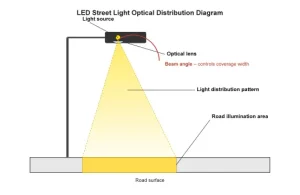
Light distribution refers to how light spreads from the fixture to the ground. Lighting coverage area, illumination uniformity, pole spacing, glare control, and overall energy efficiency all affect light distribution.
Different outdoor applications require different lighting patterns. Residential streets, highways, parking lots, and industrial areas all have different requirements. If you use the wrong distribution type, energy consumption will rise, and lighting performance will still be poor.
Importance of Right Light Distribution Types for Streetlights
Light distribution type refers to the way a streetlight spreads light over a road or outdoor area. It determines how far the light actually reaches and which areas receive more light. Different types are designed for different road widths, layouts, and lighting needs. Better light distribution keeps the streetlights well illuminated.
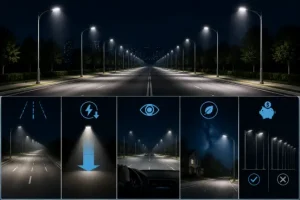
Streetlights can distribute the lighting in many ways. Among those, choosing the right light distribution is crucial. Why? First, it makes roads and public spaces safer and easier to see. Now, drivers and pedestrians can easily see the path, which reduces accidents. However, with improper light distribution, some areas receive more light than others.
This creates dark spots and makes it harder for people to see clearly. Moreover, proper light distribution helps save energy and reduces unnecessary light. It means you choose the light that is enough to light up that specific area, for example, the road. As a result, it doesn’t waste light in empty spaces or on nearby buildings. It can also reduce glare and unwanted light entering nearby homes.
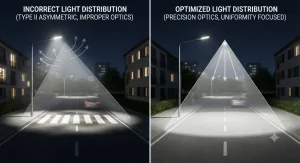
Have you ever experienced glare while walking or driving on a street? That happens because of incorrect lighting distribution. Streetlights emit a large amount of light that isn’t properly focused. As a result, this light causes glare because it isn’t focused downward. This glare can also lead to accidents. Therefore, understanding light distribution types is essential.
Main Types of Streetlight Light Distribution
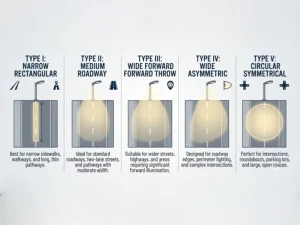
As I said above, streetlights don’t spread light the same way. Some spread light narrowly, while some spread it to a wider area. The Illuminating Engineering Society (IES) classifies streetlight distribution patterns into five main types. Let’s discuss each type and its specifications.
1- Type I Light Distribution
The first common type is Type I, a narrow, two-way light distribution pattern. It means it spreads light in two opposite directions. The light spreads evenly in both directions from the light source. That’s why it is mainly used where a small area needs to be illuminated from two sides. For example, you can find it in narrow roads, footpaths, and walkways. The light reaches both sides without needing a very wide distribution pattern.
2- Type II Light Distribution
The second type is Type II, which provides a wider spread than Type I. It is used when a streetlight needs to illuminate a narrow road or pathway from one side. In other words, the light spreads forward and sideways. This means the light spreads across the road and does not remain concentrated in one small area. Therefore, Type II is preferred for narrow streets, small roads, and pathways.
3- Type III Light Distribution
Type III light distribution is a good option when you need to cover a wide area from one side. This type spreads light forward and outward at the same time. This pattern helps the light reach farther across the road. This means that if the poles are installed on one side, the narrow light spread will not reach the other side. Here, Type III helps spread light to the other side of the road. This makes it useful for medium and wider streets, road edges, and some large parking areas.
4- Type IV Light Distribution
Type IV light distribution spreads light mainly in one direction. It sends most of its light forward and outward, not around the pole. This allows the light to reach areas farther from the streetlight. Suppose a wide road has streetlights installed along one side. The poles are close to the footpath, but vehicles also need enough light on the other side of the road. If the streetlight spreads light in every direction, some of it falls behind the pole or onto nearby land where it isn’t needed. This can waste energy. But Type IV helps avoid this problem by sending more light toward the road in one direction.
5- Type V Light Distribution
Lastly, it comes to the Type V distribution, where lights spread all around the streetlight. Unlike other types, Type V provides light on every side of the pole. That means the areas all around poles remain well lit. As you know, vehicles come from the left, right, front, or opposite side. A streetlight that sends light in one direction will not cover all these areas properly. Type V helps by spreading light in all directions. This lets more parts of the intersection receive light from a single lighting point, reducing the need for more streetlights.
How to Choose the Right Light Distribution Types for Streetlights?
Now you have a clear idea about what light distribution types are. Right? Next comes choosing the right type. Remember, choosing the wrong distribution can lead to unwanted glare, dark spots, and waste of money. But you need not worry. Here are a few factors that you must consider to make the right selection.

1- Road Width
The first thing to consider is how wide the road is where you need LED streetlights. This matters because light must reach the full road surface, not just below the streetlight. So if the road is narrow, you can choose Type I or Type II distribution. They will provide enough coverage. However, for wider roads, a wider light spread is crucial, for which Type III or Type IV are good. This is because these light distribution types cover more area. As a result, the area will be evenly illuminated, even if it is too wide.
2- Check Pole Height and Spacing
Second, check the pole height and how far apart the poles are. Pole height is the distance from the ground to the streetlight. Pole spacing means the distance between two streetlights. These two factors affect how well the light covers the road. If the poles are very high, light will reach a wider area. But if the poles are too far apart, some parts of the road will remain dark. So choose a light distribution type that works well for your pole height and the distance between poles.
3- Road Type and Traffic Volume
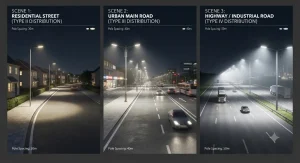
Not every road has the same purpose or the same level of activity. Residential roads are less busy than highways. So you should consider both the road type and the number of vehicles using it. For busy roads, choose the light distribution type that helps drivers notice other vehicles and pedestrians. Similarly, for residential streets, the light should not produce glare. For residential streets, you should ensure streetlights are focused downward. This ensures the light stays on the path and does not cause glare for pedestrians.
4- Required Light Levels
Every road needs a different amount of light to keep drivers and pedestrians safe at night. Busy roads usually need more light than quiet streets. Light levels are generally measured in lux, which tells us how much light reaches a surface. So choose a streetlight distribution type that provides enough light across the required road area. Before choosing a light distribution type, inspect the streetlight for rush. This way, you’ll be able to choose the right type that illuminates the street efficiently.
5- Uniformity Requirements
Uniformity means spreading light evenly across the road so some areas aren’t too bright or too dark. This is a crucial factor because you need to see the road clearly without sudden changes in brightness. Sudden changes can affect eye comfort. When choosing a light distribution type, make sure it covers the road and reduces dark spaces between streetlights. When the whole area is evenly lit, drivers can see everything clearly. If there is any bump, they can locate it and avoid it as well.
6- Energy Efficiency and Light Pollution
Energy efficiency and light pollution must be considered when choosing a light distribution type. Remember, streetlights must provide light down to show the path. Lights should not scatter and illuminate nearby areas. These include nearby buildings, trees, and so on. For more focused lighting, I recommend choosing a Type II or Type III distribution. This way, you’ll get excellent lighting down below and keep the illuminated area contained. This will also avoid light waste that can happen with scattered lighting.
Conclusion
Streetlights keep the roads and streets safe at night. However, not all lights spread light the same way. That’s where light distribution types come in. Remember, streetlights can produce excellent lighting. But without the right distribution, you can waste that light. In fact, wasted light can even lead to light pollution.
It can also cause unnecessary glare for others. Therefore, understanding the light distribution types is crucial. In this guide, I have discussed those types and how to choose the right one. Types I, II, III, IV, and V each have their own light patterns and uses. The best choice depends on road width, pole height, spacing, traffic, and the required light levels.