
Introduction
Light is something you see every day in your home offices and everywhere you go. But when you look at a light, you might notice that the light does not spread in the same way everywhere. Right? That’s where the two terms beam angle and field angle come into play. Many think that these are two similar things, but in reality, they differ a lot. This raises a question: Beam Angle VS Field Angle: What is the Difference?
Understanding this difference is crucial, especially if you are dealing with LED lights. These terms explain how light moves outward from a fixture and how much area it can cover. If you don’t know about these angles, you will end up choosing the wrong LED light. But worry not! In this guide, I will compare both beam and field angle heads head-to-head. So let’s get started.
Beam Angle VS Field Angle: Key Differences
As I said above, both light angle terms relate to how light spreads. So it is normal for you to get confused and assume they’re similar. But that’s a misconception. There are many aspects in which these light angles differ. Don’t know how? To make those differences clear, I will compare the beam and field angles below so you can fully understand them.
1-Basic Concept & Meaning
First, let’s understand the basics of each light angle. The beam angle is the angle at which the main and brightest part of the light spreads from a lighting source. It basically shows how concentrated the light is when it spreads from the light fixture. In simple words, we can say that the bright center of a light is the beam angle. On the flip side, the field angle is the total angle of light spread. It does not just include the central brighter light part but also demonstrates the weaker outer light around the main beam until it fades away. In other words, the softer outer glow around a light is part of the field angle.

2- Light Coverage & Spread
Light coverage means the part of the light each angle describes. So this is another area where both the beam and field angles vary. For example, the beam angle mainly focuses on the brightest center or core portion of the light beam. This is the area where the light looks strongest. When you talk about the main working part of a light source, you are usually referring to the beam angle. On the other hand, the field angle describes the entire spread of light. Around the brighter central portion, there is a softer glow. Right? The field angle, along with the main center point, also describes the outer, softer glow.
3-Brightness Measurement in Beam and Field Angle
Beam angle and field angle are also measured at different brightness levels. How? For example, beam angle is measured at the point where the light falls to about half (50%) of its maximum brightness. It means the beam angle measures only the strong, useful main light. However, the field angle is measured much farther out from the central point. It is measured at the point where the brightness becomes very soft, around 10% of the center brightness. Even though the light is weaker at this point, it is still visible and contributes to overall illumination. That’s why field angle counts.

4- Purpose of Angle Measurement
Now you know how each light angle is measured. But the purpose of that measurement is different for each angle. For instance, beam angle is measured to understand how focused or concentrated a light source is. It doesn’t concern the overall spread. It just helps you know whether the light will create a tight bright spot or spread widely. But the field angle measurement has a different purpose. It helps show the total visible light coverage in a specific area, not just one of its focal points. It explains how far the light will spread smoothly.
5- Overall Spread Width
Both beam angle and field angle show a clear difference when it comes to spread width. Interestingly, the beam angle has a narrower spread. The reason lies in its concentration. It focuses only on the central, brightest portion of light and ignores the dim outer edges. That’s why its spread width stays very limited. Conversely, the field angle shows a much wider spread. It measures light much farther and includes weaker light that continues spreading beyond the bright center. Due to this, its spread area increases prominently.
6- How Lights Feel to Eyes (Visual Effect)
Each lighting angle feels different to the human eye and also changes the mood of the space differently. The beam angle of the light is much narrower. A light with such a narrow beam angle produces a very small, very bright circle of light. The center of that circle is very bright as energy is concentrated there, but the outside is darker. As a result of this, your eyes notice strong brightness differences.
For example, the center will look brighter, but the nearby area is darker. It directly feels more focused and intense to your eyes. But at the same time, this focused light helps you focus on things, like a performer on the stage of any product in the shop. However, a light with a wide field angle looks and feels very soft to human eyes because it creates a larger lighting angle. Here, this light still has a brighter center, but the outer light softly spreads into nearby areas as well. Darkness does not appear suddenly, which often affects your visual perception.
7- Uses in Different Lighting Situations
Due to variation in many terms, the application of both angles also differs. For example, the beam angle is extremely important for those lights where focus is the major concern. You see spotlights, gallery lights, stage lights, and retail displays; all of them rely on beam angle. There, the beam angle helps you control exactly where the light falls, making things prominent.
On the other hand, the field angle is the choice for lights where overall visibility matters. Offices, warehouses, parking areas, and streets all depend on larger field angles. This angle helps spread the light smoothly, broadly, and softly to make nearby areas visible. However, when it comes to designer lighting, they prefer to use both of these light angles. With this combination, they ensure both concentration and overall visibility for the same place.
8- Shadow Formation
This difference concerns how shadows are created around the lit area at different light angles. When we discuss light solely in terms of beam angle, only a small area in front of you becomes bright. Areas beside the light will stay very dark. It means the beam angle creates strong shadows, and those darker shadows are very sudden as the light does not spread equally.
These shadows are useful for concentration and attention, but in larger spaces, they can affect visual perception. On the other hand, a light with a field angle does not create darker shadows. Here, the center is still brighter, but the area around you will be visible as well. Darkness appears gradually rather than suddenly. So there are no harsh shadows that can affect your eyes.
How to Choose Between Beam Angle & Field Angle
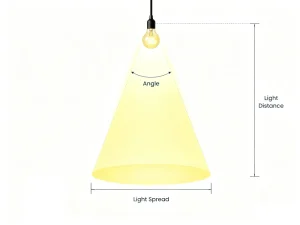
For LED lighting, the choice of angle highly depends on what you want to achieve with the light.
If your goal is to highlight something specific, like a product, artwork, or performer, a narrow beam angle is better. It will keep the light strong and focused in one area so that the thing can get attention. However, if you need to light a whole space, a wider beam angle with a larger field angle is more suitable.
Remember, each of those lighting angles has its own weaknesses and strengths. So the final choice is up to you. As you know, every space has its own needs. If you want to light up a small area and highlight things, the beam angle is the best option. It will spread the light to smaller areas, which enhances lighting efficiency.
But for larger spaces, beam angle is not a good option. For such needs, you have to go for the large field angle. This lighting angle is efficient at spreading light over a large area. The nearby area might be brighter, but still, the faraway area also remains brighter to some extent. So now that you know the differences in lighting angles and their uses, it’s quite easy to choose the best LED lighting angle for your needs.
Frequently Asked Questions
Is the field angle always larger than the beam angle?
Yes, the field angle is almost always larger than the beam angle. The reason is that the field angle measures a wider portion of light, but beams measure only the brighter central portion. This automatically increases the field angle.
Does beam angle affect brightness?
Yes, the beam angle strongly affects how bright a light appears in a given area. If the beam t angle is narrow, it will concentrate the light into a small space. This makes the nearby area darker. However, if the beam angle is wide, the light will spread out, making the surroundings brighter.
Can two lights have the same brightness but different beam angles?
Yes. Two lights can have the same total brightness (same light output), but different beam angles. This is true for both narrow and wide beam angles. Here, the brightness is the same overall, but the lighting effect feels different due to the different light-spread width.
Are beam angle and field angle only used in LED lighting?
No. Beam angle and field angle are not only used in LED lighting. They are also used in systems like flashlights, stage lights, projectors, car headlights, and street lights.
Conclusion
Lighting angle is all about how the light behaves when it leaves the fixture. You will often find two types of lighting angles: beam and field angles. At first, it seems these angles are the same thing. But in reality, there are several aspects in which each of these angles varies that I have discussed in this guide. For example, the beam angle spreads light to a smaller area and focuses on highlighting. On the flip side, the field angle is a large lighting angle that spreads the light to a wider area. It does not focus on light concentration but on dispersion. So when you understand this difference, it becomes easier to choose the right lighting for any situation.