
Introduction:
The lighting of football fields has been greatly improved with the advent of LED technology. It’s more energy-efficient, provides better light, and is easier to control than before. These advanced lighting systems ensure clear vision for the person involved in the game. Players see the ball and field with perfect clarity. Officials can make accurate calls with confidence; Spectators enjoy a crystal-clear view of all the action. Simultaneously, they fulfill the stringent technical standards required by broadcast media. In this guide, we’ll explore LED football field lighting.

Key Requirements for Football Field Lighting
1. Uses
Firstly, the required lighting level depends on the field’s use. We measure field brightness using two types of light. The horizontal light that illuminates the playing surface. And the vertical light that supports television broadcasts. For example, the field needs to be flooded with very bright light—between 1,400 and 2,000 lux. It aims to broadcast an international game in high definition. For amateur levels and above, they explicitly required vertical illuminance. Especially for broadcasts, it often requires 1,500-2,000 lux or more. It aims to ensure clear, shadow-free television pictures.
2. Uniformity
Beyond illuminance, several other factors are crucial for high-quality football field lighting. Uniformity can measure how evenly light is distributed across the field. Good uniformity, such as a ratio closer to 1.0, can prevent dark spots and shadows. It can also ensure consistent visibility for players and cameras.
3. Glare Control
Glare Control is also a key requirement for football field lighting. Excessive glare can hinder the vision of players, officials, and spectators. By carefully designing, positioning, and aiming the lights, we can effectively control glare.
4. Color Rendering Index (CRI)
The Color Rendering Index (CRI) shows how well a light displays colors compared to natural sunlight. Football field lights need a CRI of at least 80. This makes colors look real and vivid for everyone—players, fans, and TV viewers.
5. Protection(IP) Rating
Not only that, but Ingress Protection(IP) Rating is an essential factor. Football field lights are installed outdoors. So we must protect them against dust and moisture. Outdoor sports lights must have a high weatherproof rating. For instance, IP65 or IP66 can handle rain, dust, and other outdoor conditions.
Why Choose LED Lights for Football Field Lighting
1. High Efficiency
Firstly, compared to traditional metal halide lamps, LED lights offer higher energy efficiency, a longer lifespan, and better controllability. They can achieve energy savings of over 65% and need less maintenance.

2. Safety
Secondly, a football field with lights can reduce the incidence of injury events. The excellent lighting ensures everyone sees the game in vivid, accurate colors. These professional LED lights are designed for visual comfort. These stadium lights feature advanced anti-glare technology. LED lights can prevent intense light from affecting players’ vision. It also keeps spectators comfortable.
3. Flicker-free
Additionally, the lights are completely flicker-free. Flicker-free lighting lets everyone watch comfortably throughout long matches. The lighting stays consistent and easy on the eyes. The illumination across the field is very even. There are no noticeable bright or dark spots. This situation means the ball stays clearly visible at all times. Players can easily track it, no matter where it is on the field.
4. Smart Control Functions
LEDs can automatically adjust brightness. The system also changes the color temperature when needed. Besides, it can change the lighting angles. All these adjustments are based on specific conditions. These include the type of match being played. And we are supposed to take weather conditions into account. The system even adjusts for the time of day. For training sessions, it uses lower light levels. During official matches, it increases to standard brightness. These changes provide lighting exactly when and where needed. The system prevents unnecessary energy waste.
5. Environmental Protection
Last but not least, LED technology offers significant environmental advantages. Unlike traditional lighting, it contains no mercury or other hazardous materials. LED lighting is an eco-friendly solution for sports venues. When paired with solar power systems, these lights can operate completely off-grid. This provides reliable illumination even for football fields in remote locations.
Types of LED Flood Lights for Football Fields
LED football field lighting comes in different types. We choose them based on the specific situation. Each usage scenario has its own requirements. So the right choice depends on the field’s needs.
Some football fields have basic lighting needs. These include amateur training fields and community pitches. School grounds also fall into this category. For these venues, simple installation is adequate. Hence, easy maintenance is also sufficient. We can choose from 200W to 400W LED floodlights.

Some venues need better quality lighting. For instance, regional league fields and professional training bases. The illumination should be more uniform. The lighting should also support amateur TV broadcasts. For these cases, 500W-800W LED floodlights are recommended.
Compared to the above, professional stadiums have strict lighting requirements. These include venues for professional leagues and TV broadcasts. They must meet FIFA and UEFA standards. They also need to support HDTV broadcasting. For such applications, 1000W-1200W LED floodlights are the ideal choice.
In summary, higher-standard football fields demand more powerful lighting systems. As the required illumination level increases, the wattage of the floodlights needed increases.
Football Field Lighting Design Considerations
Designing an excellent football field lighting system requires careful consideration of multiple factors. It goes far beyond just choosing bright lights. The process involves technical planning, compliance with standards, and practical implementation aspects. Finally, long-term operational and maintenance requirements need to be considered from the outset. Below are the core design considerations for a successful lighting scheme.
A Clear Purpose
First, the planning process must begin with a clear purpose. As we all know, different competition levels need dramatically different lighting. For example, a training field requires much simpler lighting than a broadcast-quality venue. Training and recreational areas only need to meet basic needs. By contrast, a broadcast-quality venue requirement is stricter than a training field. So, you should consider the field type you want to build at the beginning.
Optical Design and Performance
Secondly, we must consider optical design and performance.
- For light distribution type, modern football field lighting typically uses an asymmetric distribution. This design projects light precisely onto the field instead of scattering it into surrounding areas. This approach significantly improves both energy efficiency and glare control. We should select beam angles—narrow, medium, or wide—based on the mast height and position. This selection is crucial for achieving optimal coverage and uniformity.
- For glare control, luminaires utilize built-in louvers, baffles, or special optical lenses. These components strictly limit direct light from reaching players’ and spectators’ eyes. This is crucial for ensuring game safety and optimal viewing comfort.
High-Performance Luminaires
Designing football field flood lighting requires careful luminaire selection. For example, the luminaires need an IP65/IP66 or higher rating for performance specifications. This protection level ensures they withstand harsh outdoor conditions, such as rain and dust, in the long term. Additionally, high-quality thermal design, using materials such as high-conductivity aluminum, is essential. This approach helps LED luminaires achieve their rated lifespan of 50,000 hours. Selecting branded LED chips and driver power supplies ensures long-term system reliability.
Right Lighting Layout Scheme
Football field lighting layout schemes are essential. For example, flood lighting is the most mainstream and recommended scheme. Masts are placed along the two long sides of the pitch. This is the standard for TV broadcast venues.
Besides, four-corner Lighting is suitable for small, medium-sized, or budget-conscious fields. Lower cost but requires careful design to avoid shadows in the center of the field.
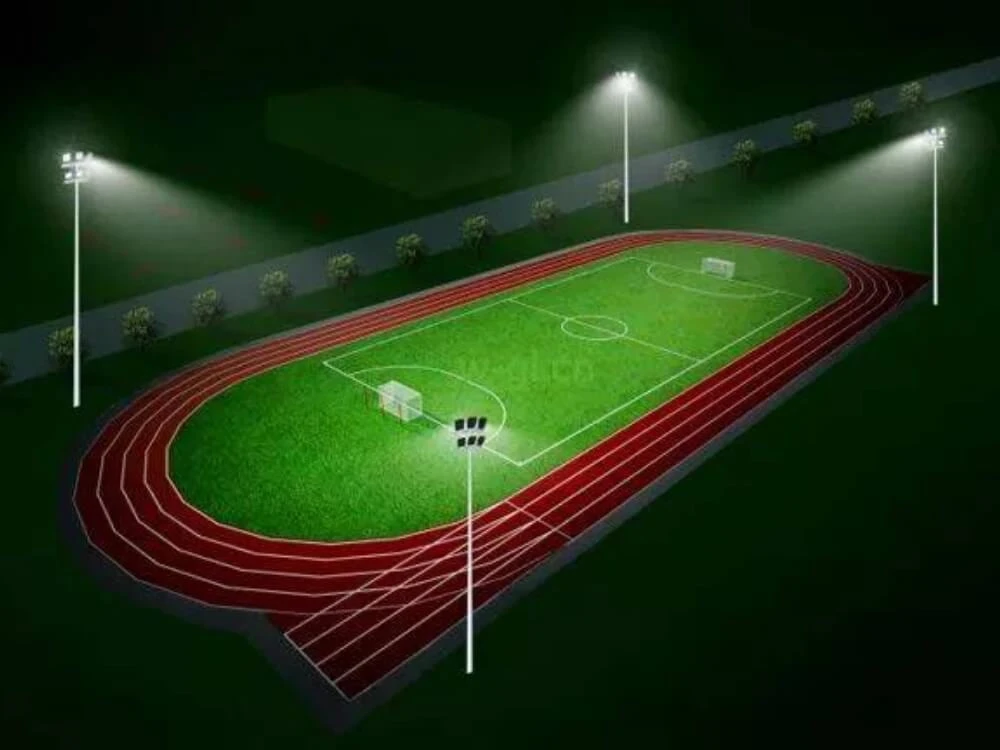
And glare control is more challenging. The Mixed Lighting approach combines the best features of both systems. Designers deploy this solution in top-tier professional stadiums. It delivers the most perfect lighting results for high-level competitions.
Not only that, mast positioning is necessary. Professional fields require specific mast heights. Designers typically install side masts at a height of 25-45 meters. This height range ensures an adequate light-throw distance. It also guarantees optimal illumination uniformity across the playing surface. Corner masts can be slightly lower. Installation teams must position masts well back from the touchlines. They also need to maintain proper angles toward goalkeepers and corner flags. This careful placement prevents glare from affecting players’ vision during matches.
Installation & Maintenance Tips
- Consider the weight and mounting methods of football field lights.
- Choose football field lights designs with easy access for maintenance.
- Evaluate long-term operational costs to avoid excessive expenses.
Cost of LED Football Field Lighting
Cost differences are mainly affected by many factors. These factors include lamp specifications and quality, whether the lamp consists of an intelligent control system, installation costs, and supporting projects (such as lamp poles, cables, and distribution boxes).
Conclusion
LED technology now leads the field in football field lighting. It delivers exceptional efficiency, precise control, and outstanding performance. It also dramatically lowers operational expenses and environmental impact.
LED football field lighting will continue improving the football experience for everyone involved. Players benefit from better on-field visibility. Spectators enjoy clearer views from the stands. Broadcast audiences worldwide receive higher-quality viewing experiences.