
Introduction
Most probably, you often park your vehicle outside the hospital, shopping mall, warehouse, or school. This space is what we call a parking lot. However, for this space, lighting plays a very critical role. During the day, natural sunlight makes this easy. However, once the sun goes down, proper artificial lighting becomes essential. In the past, traditional lighting options consumed a lot of energy. To cope with this issue, LED parking lot lights have now come onto the scene. However, designing these lights for parking lots is not much easier. That’s where this LED parking lot lighting design guide will help you. You will learn about the entire lighting design process and factors to consider when designing them. So let’s get started.

Why Is Proper Parking Lot Lighting Design Important?
Nowadays, a parking lot is more than just a place to leave vehicles. Every day, many people drive through it, walk to and from their cars, and carry shopping bags, luggage, or other items. Right? Now, if the lighting is poor, it will become very hard to see things and even people, which might sometimes lead to accidents.
That’s why proper lighting is key for such spaces. Good lighting, first of all, helps people feel more secure. Actually, when the light is evenly distributed, there is no chances of dark corners or spots. Drivers and pedestrians can see and notice other vehicles more easily. As a result, visitors often feel more comfortable using a well-lit parking lot.
Secondly, proper lighting design is also key for energy efficiency. How? Remember, installing the brightest lights does not always mean the best lighting results. When you install lights in the wrong location, you just waste electricity. Some areas will be brighter while some will be darker. But lighting design helps you place the light where it is needed most. This reduces the unwanted extra lights and cuts down electricity bills.
LED Parking Lot Lighting Design Process: Step-by-Step
Now you understand why the LED parking lot lighting design is so important. Right? Next, it comes to how to actually design these lights. If you are a beginner, it might feel technical. But in reality, if you follow some steps, you will get it more easily. So let’s dive in and explain the main steps involved in designing the LED parking lot lighting.

Step 1: Measure the parking lot & Identify Entrances
The very first thing you have to do is measure the parking lot. As you know, not all parking lots are always the same. They might be different in shape, like rectangles or circles. Some lots also have multiple sections or irregular layouts. That’s why you must know the exact size and layout of the parking lot where you want to install LED lights. For this, first measure its length and width and note its overall shape.
It is best to write down all your measurements in a notepad. After that, identify all the important areas within the parking lot. Look at the vehicle entrances and exits, parking spaces, pedestrian walkways, and loading areas. These areas basically need special attention. Why? Because they experience the most traffic and activity throughout the day, lighting must be right here.
Step 2: Determine Brightness Needs & Choose Pole Height
Once you understand the layout of the parking lot, next you have to know how much light the area actually needs. Know that not every parking lot needs equal brightness. Suppose you are planning LED lights for a parking lot outside a shopping mall, hospital, or airport. It will definitely need brighter lighting. The reason is that these are spaces many people and vehicles use day and night.
But in contrast, if there is a small residential or private parking area, it will require less light. Overall, your goal when determining brightness should be to ensure the areas do not look too harsh or too dim. It should complement the parking lot’s needs. After determining the required brightness, you next have to choose the right pole height. This height is what directly affects the light spread.
Taller poles usually allow light to cover a larger area, so fewer poles are needed. So these taller poles are best for large commercial or industrial parking lots. On the flip side, shorter poles concentrate the light on smaller areas. As a result, you will need more LED fixtures to illuminate a parking lot. But these shorter poles can work well for smaller parking lots where too many lights are not needed.
Step 3: Select Fixture Wattage & Decide Spacing
Now you have decided on the overall brightness needed and the pole height. Right? Next, you have to choose the right LED fixture wattage. Wattage basically tells you how much electricity a light will use. But this wattage does not indicate the brightness. In other words, more wattage does not mean more brightness. Now there are LED lights that produce a large amount of light while using little power.
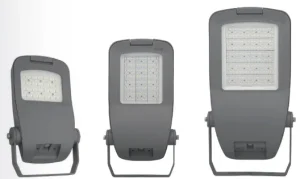
So for the right wattage, you have to depend on the size and layout of the parking lot and the height of the poles. For instance, if you are designing lighting for large parking lots, you will use taller poles. Thus, for taller poles, you will need higher-wattage LED lights to provide enough lighting.
Once the fixture is selected, it is time to decide the spacing between lighting poles. It is very important, as too far poles will create dark spots and too close poles will create over-brightness. So, to find the right distance between these poles, always keep in mind your LED light’s brightness level and pole height. If you have chosen high-wattage LED floodlights for taller poles, these poles must be spaced farther apart.

Step 4: Check Uniformity & Reduce Glare
Uniformity means the even spread of light. Once you have installed the right LED lights, you also need to check that each area in the parking lot receives a similar level of light. Sometimes, some areas look too bright and others too dark. If there are sudden changes between bright and dark areas, people’s eyes need time to adjust.
As a result, they might not see things properly, leading to accidents. So move all around the parking lot and check that every part is getting even lighting. If you notice darker or brighter spots, you will need to relocate the poles or change their spacing. Moreover, when installing LED lights in parking lots, glare sometimes arises.
In this case, the light is too bright and shines directly into a person’s eyes. Too much glare makes it difficult for drivers and pedestrians to see clearly and reduces visibility. So you must remove it using a few methods. First of all, choose fixtures that direct light towards the ground rather than into people’s eyes. Secondly, install the light at the right height and choose the right beam angle.
Step 5: Add Smart Controls & Test Lighting
After ensuring all the important things, the final step is to add smart controls for the LED lights. Smart controls automatically turn the lights on and off. This system can even adjust its brightness based on the surrounding conditions. It means the lights will be used only when needed, which reduces electricity bills. For these controls, you can add a photocell sensor.
It will switch the lights on when it gets dark and turn them off after sunrise. You can also use a motion sensor. This sensor will brighten the lights when people or vehicles are nearby and dim them when the parking lot is empty. This control makes the overall LED parking lot lighting very efficient. After you have added everything, it’s finally time to test the entire lighting system.
From the outside, it might look as if everything is right. But the real outcome comes after testing. So walk through different parts of the parking lot and check for dark spots, overly bright areas, or glare. Make sure entrances, exits, parking spaces, walkways, and driving lanes are clearly visible. If you find a problem at this stage, you can fix it by knowing the reasons.
Main Factors to Consider When Designing LED Parking Lot Lighting
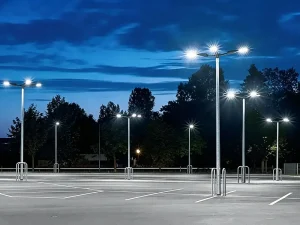
If you think that designing the LED lighting for parking lots is just about selecting and installing them, you are wrong. Remember, every parking lot has different lighting needs. So a single design cannot work for all. That’s why, before making a final plan for lighting a parking lot, here are a few factors you must consider.
Required Brightness (Illuminance)
The first thing to know is the illuminance it needs. The amount of light that reaches the ground or any surface is illuminance. So, that illuminance mainly depends on the location of the parking lot. If it is located in a busy area, you will need more lumens and vice versa.
Color Rendering Index (CRI)
Another critical factor to consider is CRI. CRI tells you how accurately an LED light shows the real colors of objects. So when choosing LED lights for parking lots, opt for a higher CRI. Why? Because it will help people recognize the true colors of vehicles, road signs, parking lines, etc., at night.
Local Lighting Standards
Each city, state, or country has its own rules about outdoor lighting. These rules ensure that parking lots are safe for people and do not disturb nearby homes. So, before installing these lights for parking lots, it is a good idea to check the local requirements. They will tell you how much brightness is allowed, the maximum glare level, and recommend a uniformity level.
Lumens Instead of Watts
When choosing LED lights for parking lots, you might focus on lumens. But with modern LED lighting, this is not the best way to compare lights. This is because watts are about how much electricity the bulb uses, and lumens are about brightness. So it is possible that two 100-watt LED lights produce different brightness levels. That’s why you should always look at the lumen level instead of brightness.
Beam Angle
Lastly, there is a beam angle factor you should not ignore. The beam angle describes how widely or narrowly the light spreads after it leaves the fixture. It directly tells you how much area one light can cover. So you must choose the right LED beam angle based on the parking lot’s size and layout.
Conclusion
Parking lots are the places where you park your vehicle almost every day. But lighting in these areas is critical to the safety of people and vehicles. Now, LED lights are considered the best option for lighting these spaces. However, a proper lighting design guide is very crucial for the best results. For this, I have discussed some steps you can follow to achieve the best lighting effects. Each of these steps, from measurements and conformity to smart control and the final test, is equally important. But also remember that each parking lot has its own needs. So before you make the final decision, always consider beam angle, pole spacing, pole height, and lumens.