
Introduction
Highway lighting plays an essential role in modern transportation infrastructure. LED highway lighting provides a brighter, clearer visual experience than traditional high-pressure sodium lamps. Choosing the right LED highway lights can optimize efficiency and save costs. This guide provides a comprehensive overview of LED highway lighting.
Advantages of LED Highway Lighting

Outstanding Energy Efficiency
LEDs offer far higher system efficacy than HPS or metal-halide lamps. As a result, LEDs deliver higher light output with lower power consumption.
Real-World Energy Savings
The energy-saving rate of LEDs can reach 40%-60%, thereby directly reducing costs. Highways typically require tens of thousands of luminaires. These luminaires need to be lit up all night. So, the savings in electricity costs are substantial.
Lower Long-Term Costs
High-quality LED highway lights are rated for 100,000+ hours (L90). That’s often 5–10 times the life of traditional high-pressure sodium lamps. A long lifespan means a low replacement frequency. It is challenging to maintain lamps on highways. So, reducing the number of maintenance times means saving the workforce and costs.
Superior Optical Performance
LED lights have a color rendering index (CRI) of 70-80+ and a color temperature of up to 3000K or 4000K. The color rendering of the LED lights is much better than the dim yellow light emitted by high-pressure sodium lamps. Higher CRI improves object recognition and color perception. This can allow drivers to identify roadside obstacles more clearly.
Instant On & Adaptive Control
LEDs reach full brightness the moment they’re powered on. Unlike traditional lighting technologies, LEDs do not require a warm-up period.
LEDs can be linked to sensors to achieve the intelligent mode: “lights on when a car comes and off when it leaves”.
Built to Last in Tough Conditions
LEDs are solid-state devices with no filaments or glass envelopes. It is more resistant to vibration and shock. It is suitable for continuous vibration environments caused by passing vehicles on highways.
Environmentally Friendly
LEDs are environmentally friendly. They do not contain harmful materials such as mercury.
Technical Requirements for LED Highway Lighting

Brightness and illuminance
- Main lanes typically require an average illuminance of 20–30 lx, depending on road classification and traffic conditions; key areas like interchanges and tunnel entrances usually require higher illumination levels, often up to 50 lx or more.
- An overall uniformity of ≥0.4 is recommended to avoid excessively bright or dark areas on the roadway.
Glare control
Strict control of glare is essential. Use cut-off street lights. Their optical design strictly limits the light emission angle on the horizontal plane.
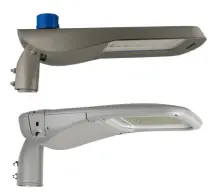
This reduces direct light from entering the eyes of drivers or pedestrians and minimize direct glare at the source.
Color temperature and color rendering
- Maintain the color temperature consistently along the same section of the road.
- Lower color temperatures improve light penetration in foggy or rainy conditions.
- In addition, after the lamps have been lit for 3000 hours, the color stability deviation should not exceed 0.0100. This can ensure a stable light color and avoid driver visual fatigue.
Mounting height and pole spacing
- Streetlights are typically 8-12 meters high. This distance increases the distance between the light source and the driver’s line of sight, reducing glare.
- Pole spacing is approximately 3-4 times the height. This arrangement prevents light overlap and dark areas, ensuring uniform road illumination.
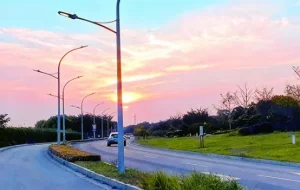
Highway Lighting Requirements by Different Road Sections
Different highway sections present distinct lighting challenges and therefore require tailored lighting solutions.
Highway sections within urban areas
These sections are typically located near urban areas and experience high traffic volume. Continuous lighting is generally required.
Lighting standards can be adjusted based on traffic volume. Higher standards are used for high-traffic volume, and lower standards for low-traffic volume.
Cut-off type LED streetlights are recommended. The installation height should be 10–12 m. The spacing between lampposts should be 30–40 m.
The average road surface illuminance should not be less than 30 lx. It should also be coordinated with the surrounding urban lighting environment to avoid substantial light interference to nearby residents.
Interchanges and service areas
Interchanges and service areas are large-scale and often use high-mast lighting. High-mast lights are generally 25–30 m high. They are often used in conjunction with multi-purpose LED floodlights, with a spacing of 20–25 m between luminaires.
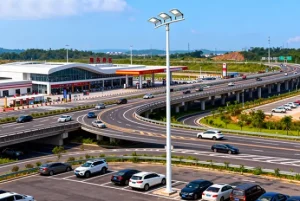
High-mast lights should be equipped with lifting devices for easy maintenance. The lighting design should address merging lanes and parking lots to avoid blind spots.
Tunnel entrances and exits
Transitional lighting fixtures are recommended for tunnel entrances and exits. This can reduce the visual impact of sudden changes between light and dark environments.
Lead-in lighting should also be installed to provide a gradual change in illuminance.
This smooth transition helps drivers adapt to changing lighting conditions, reducing the risk of accidents.
LED Highway Lights Selection Guidelines
- Define your project requirements. First, determine the road class (main expressways, ramps, and more), lamp pole height, spacing, and the required illuminance and uniformity levels.
- Shortlist fixtures that actually meet the spec. Based on the above requirements, pick products that meet the right light output, light distribution, and protection ratings.
- Evaluate brand and supplier. When choosing LED highway lights, we should select a manufacturer with a good reputation and extensive experience. Besides, we need to check relevant qualifications and test reports. For example, KANGLIGHT has over 30 years of experience in the field of road lighting. Our optical design engineers, with over 10 years of experience, provide professional light distribution solutions for your projects. In addition, our LED highway lights feature long lifespans, high energy efficiency, and robust construction. Furthermore, they meet international safety and protection standards.
- Test and compare samples in the real world. We should measure the samples’ photoelectric parameters and photometric curves. If possible, set up a mock-up on site.
- Calculate total cost. Although high-quality LEDs cost more upfront, their total costs are low. They have an extremely long lifespan, low energy consumption, and low maintenance costs.
- Ensure the warranty and after-sales service. Confirm the warranty period and the after-sales response mechanism. We should choose a manufacturer with reliable post-purchase service.
Conclusion
LEDs are the best choice for highway lighting. They have high energy efficiency and low energy consumption. Besides, they are environmentally friendly. We do not need to worry about light pollution. Additionally, LEDs can be matched with an intelligent control system. It is beneficial to build an intelligent highway network.
With the right luminaires, optics, and intelligent control systems, highway lighting can significantly improve driving comfort and safety while reducing operational costs.